Team

Myself (Solo Designer)

2 Product Managers, and

2 Developers

Myself (Solo Designer)

2 Product Managers, and

2 Developers

Myself (Solo Designer)

2 Product Managers, and

2 Developers

Responsibilities

Product Design, 

UX Design, Research, analysis, and

Prototyping

Product Design, 

UX Design, Research, analysis, and

Prototyping

Product Design, 

UX Design, Research, analysis, and

Prototyping

Year

2023-2024

2023-2024

2023-2024

Overview

ProjectBoard+ is an end-to-end platform that helps schools and STEM organizations manage science fairs, from event setup to judging and awards. The idea emerged during the COVID-19 pandemic, when science fairs were forced to move online and educators needed better tools to run events virtually.

By bringing event creation, participant onboarding, and judging workflows into a single platform, ProjectBoard+ simplified science fair management for educators.

ProjectBoard+ is an end-to-end platform that helps schools and STEM organizations manage science fairs, from event setup to judging and awards. The idea emerged during the COVID-19 pandemic, when science fairs were forced to move online and educators needed better tools to run events virtually.

By bringing event creation, participant onboarding, and judging workflows into a single platform, ProjectBoard+ simplified science fair management for educators.

The problem

As the platform grew, a core problem surfaced: collaboration between students, educators, and judges was breaking down. Communication was scattered across tools, resources were siloed, and there was no shared source of truth.

The design challenge was to unify these workflows without adding complexity — so the platform could actually support the learning it was built around.

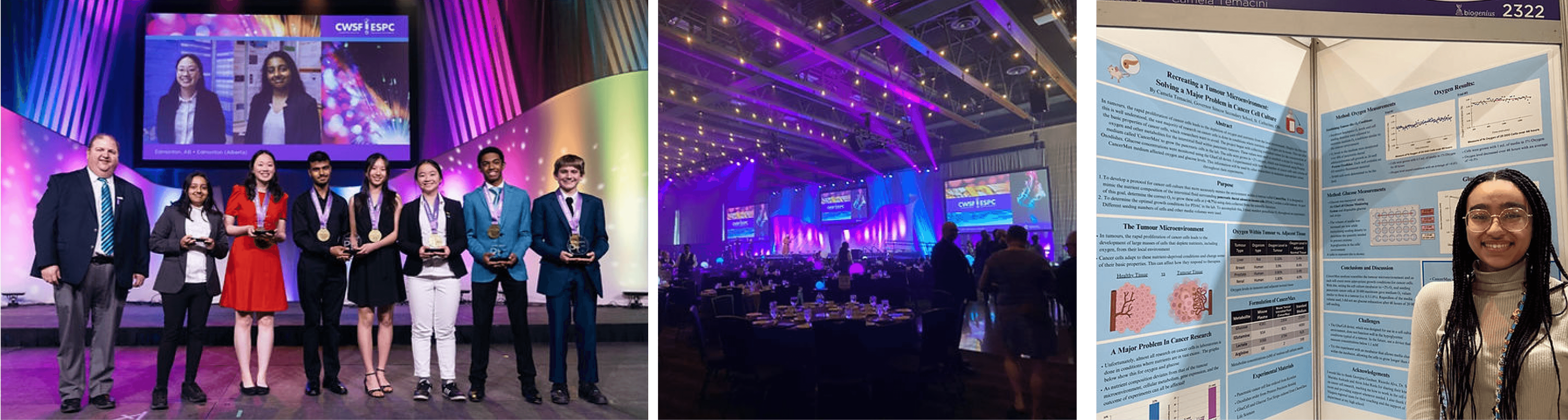
I'd never been to a science fair as an adult... so I went to one.

I flew out to the Canada Wide Science Fair in Edmonton, walked the floor, and spent time with the people actually using ProjectBoard. Students scrambling to submit projects and teachers trying to hold everything together. Watching it happen in real time told me more than any survey ever could.
Understanding the existing users

Attending the CWSF in Edmonton revealed these patterns shaping the redesign.

Teachers had no centralized view to monitor submissions, track progress, and award projects across events.

Acting as both admin and judge was common, but the platform treated these as separate identities

Teachers had no way to bring in co-admins or delegate responsibilities natively.

Approach

Educators are already stretched thin — the last thing they need is a platform that makes them work to understand it. That became my north star: if something created friction, it didn't belong.

When I looked at other event management tools, a pattern kept showing up, they were built for people who already knew what they were doing. I wanted to flip that. Start people with a template, walk them through setup step by step, and make the right next action obvious at every point.

The process was messy in the best way. I'd ship something, watch where it broke down, and go back in. Every feedback round taught me something I wouldn't have caught on my own.

Solution

The research kept pointing to the same frustration: teachers were juggling too many tools just to run a single event. I designed a centralized dashboard so everything lives in one place: event creation, participant tracking, and judging. Role-switching lets teachers move between admin and judge views without logging out or losing their place.

Design Process

How might we give educators the tools to run science fairs themselves — without needing us in the room?

The original setup wasn't really a product. Schools would come to ProjectBoard with their requirements, and we'd build out a custom webpage for students to fill in. Teachers had no control, nothing was reusable, and every new event meant starting over. It worked barely but it didn't scale.


The shift was designing a self-serve platform where teachers could come in, set up their own event, and actually own the process end to end.

The original setup wasn't really a product. Schools would come to ProjectBoard with their requirements, and we'd build out a custom webpage for students to fill in. Teachers had no control, nothing was reusable, and every new event meant starting over. It worked barely but it didn't scale.


The shift was designing a self-serve platform where teachers could come in, set up their own event, and actually own the process end to end.

One moment at CWSF stuck with me.

Students were cutting and taping printouts because ProjectBoard couldn't generate the fair's display template. A completely avoidable gap, and a reminder that the experience doesn't end at submission.


We scoped it out this version and focused on getting the core flow live. Feedback shaped the details; the direction didn't change much once the admin flow clicked.

Students were cutting and taping printouts because ProjectBoard couldn't generate the fair's display template. A completely avoidable gap, and a reminder that the experience doesn't end at submission.


We scoped it out this version and focused on getting the core flow live. Feedback shaped the details; the direction didn't change much once the admin flow clicked.

Judging portal

Judging was one of the most manual parts of running a science fair. I built the portal directly into the admin panel so organizers never had to leave to manage it. Admins set up timelines, create registration forms, and write custom questionnaires for judges — then review and approve applications and notify them, all from one place.

The pairing happens automatically based on questionnaire responses, but admins can always adjust manually. Smart defaults with room for human judgment.

Learnings & Outcome

The platform is trusted by national STEM organizations including CWSF and ISEF.

Educators create and manage events 2x faster, with significantly less manual coordination.

Students have real-time visibility into their projects, events, and awards, keeping them engaged throughout the process.

I'd love to hear from you and explore collaboration,
answer your questions, or simply chat.

Friday, July 24, 2026

© 2026 — Amrutha Kuduva

I'd love to hear from you
and explore collaboration,
answer your questions, or simply chat.

Friday, July 24, 2026

© 2026 — Amrutha Kuduva

I'd love to hear from you and explore collaboration, answer your questions,
or simply chat.

Friday, July 24, 2026

© 2026 — Amrutha Kuduva